Monday, September 7, 2009

"Urim & Thummim"


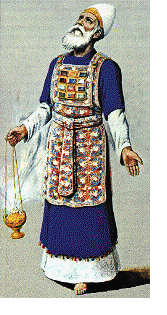
In ancient days the priests of the Hebrews wore upon their breastplates over their hearts certain jewels called “Urim and Thummim,” meaning "Lights and Perfection,” by which they received answers from God. When their people were beset on every hand by enemies, and at their wits’ ends to know which way to turn, the priests turned to God. After purifying themselves and praying they asked God, “Shall we do thus?“ and they watched the Urim and Thummim jewels for the answer. If the jewels appeared dark and opaque the answer was, No. But if they lighted up, as a human face lights when it hears good news, then the answer was, Yes. And the people grew lighter too, and went and did as God had indicated.
Now, right along beside this story of ancient people I will tell you another—tell it just as ‘twas told to me, by a woman of to-day, whose name you have doubtless heard. She writes: “I was washing my breakfast dishes one morning and the thought came to me that I would go and see a friend who lived several miles away. I finished my work and started to dress for my journey, when there came over me such a feeling of depression, or despondency, or gloom, that I was startled. I kept on getting ready, at the same time trying to reason away the feeling. But it would not go. Finally, having donned my hat and one glove I started for the door, when such a wave of heaviness came over me that I went back into my room and sat down, and I said ‘God, I want to know the meaning of all this.' And the answer came loud, strong, firm, ‘Stay at home.’ I staid, and as I took off my coat and hat such a feeling of lightness and relief came over me that I seemed to walk on air. At the time I supposed the voice (I call it a voice for want of a more defi nite term) had told me to stay at home because someone was coming who needed my help. But no one came that day or night, and several times the thought flitted through my mind that perhaps it was all nonsense after all, and that I might as well have gone. Well, the outcome was that the train I would have taken, had I gone, met with a fearful accident wherein many were killed or badly wounded. This is only one of many such experiences I have had.” And I could tell you still others on my own account.
The One Great Intelligence has built in every human heart a "Urim and Thummim,” which, as a guide, transcends any human brain that ever existed, or ever will.
Elizabeth Towne

Sunday, September 6, 2009

Feminine Power the Lakota Way


“Our way of leading is a combination of very direct and indirect at the same time, ”Pansy says. “This is the story of the spider and the spider web. If you look at the spider web it is a very light and fine material. And the spider is very heavy. There’s a lot of weight there, but the web holds. The Lakota style of leading is similar in that what seems is not what is. It might not look like you’re leading. We don’t lead by moving people around, telling them what to do. A leader is present in the background. The leading is hidden, like the spider’s web, but the job gets done, like the spider being held. Even though you are a leader, you have to continue to work, to follow, to listen, to watch, to support those in front of you. In your strength you’re leading, but it makes you focus on your skills as a follower.
The power of getting things done in an outer sense is not how it is in sacred space. In sacred space I’ll know I need to say something by listening inside, and only when I’m talking do I know what it is I’m saying.”
In ceremony, intuition and spontaneity are the ruling factors, and intuition and spontaneity are only possible from a place of space and freedom. Pansy offers an example of this unstructured power. “We show up ten days before the huge Sun Dance starts. At the Sun Dance there’s maybe three to four hundred people camped. Ten days before the ceremony nothing is done, nothing is started. We show up and people kind of know what they do best. And they go, and they get it done. There are people who chop wood, there are people who prepare the arbor, there are people who prepare the sweat lodges, people who get the food, people who get the stones. We don’t have a manager! We don’t have a director! Each component just starts happening, then it sort of comes together.
“About half way through you can see form taking place. And the arbor where we do the ceremony starts to come together. The women go and pull the cactus so the dancers don’t step on the cactus. Minor details, but everything is taken care of. Down to the last detail everything is done. And there is not one person taking reports on how things are going. No one gets fired for not doing their part. None of that kind of external structure works. People from inside out are doing the work.
Excerpt from The Unknown She, by Hilary Hart

Saturday, September 5, 2009

Silver Lining


"The inner side of every cloud
Is bright and shining;
I therefore turn my clouds about,
And always wear them inside out--
To show the lining."

James Whitcomb Riley

Friday, September 4, 2009

Wednesday, September 2, 2009

Face to the Sun


Strong, positive thoughts of condemnation to anyone by any person will strike that one and give him the physical sensation of having been hit in the pit of the stomach with a cobblestone. If he does not immediately rouse himself to throw off the feeling--as he easily can do by looking into his Father's face and saying over and over until it becomes realty to him, "Thou, God, approvest me"--it will destroy for the time being his consciousness of perfect life, and he will fall into a belief of weakness and bitter discouragement more quickly than from any other cause.Emilie Cady

The song of the bird


From Anthony De Mello’s The song of the bird

A girl in the fishing village became an unwed
mother and after several beatings finally revealed
who the father of the child was: the Zen master
living on the outskirts of the village.

The villagers trooped into the master’s house,
rudely disturbed his meditation, denounced him
as a hypocrite, and told him to keep the baby.
All the master said was, “Very well. Very Well.”

He picked the baby up
and made arrangements
for a woman from the village to feed and clothe
and look after it at his expense.

The master’s name was ruined and his disciples
all abandoned him.

When this had gone on for a year, the girl
who had borne the child could stand it no longer
and finally confessed that she had lied. The father
of the child was the boy next door.

The villagers were most contrite. They prostrated
themselves at the feet of the master to beg his pardon
and to ask for the child back. The master returned
the child. And all he said was, “Very well. Very Well”

Tuesday, September 1, 2009

The Power of Silence


The great philosophy of this silence is that there is in you a mighty nothing, a quietness that has been from the great forever and always will be. It is the master of goodness, that still place, that Holy of Holies. It is your power of abandonment, your child-likeness, and in that, it rests, waiting for you to move. It is a mighty vacuum that causes all motion but in itself does not move. Oh, that being nothing-—nothing of yourself! When that feeling of having so much to do, of being so important, and you must do things or they will not be done, rises up, about that time let go and enter into your own sweet nothingness. Stop thinking. You can do it. Just remember there is a power to stop thinking, and if, suddenly, you should find your mind a blank, know then, you are practicing the perfect concentration of repose.
By Annie Rix Militz